
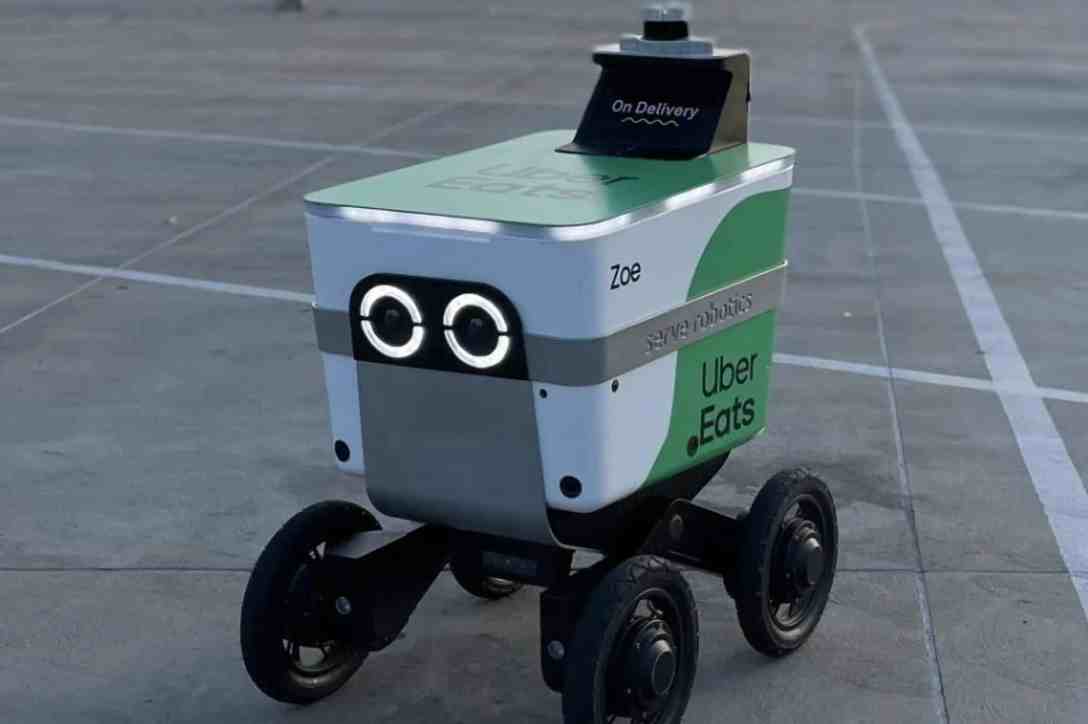
Barcelona, June 5, 2023.- The latest food delivery with autonomous robots has not worked in all countries. In the United States, Uber Eats seems to have found the formula for success:
Serve Robotics is set to expand its partnership with Uber Eats, deploying up to 2,000 autonomous sidewalk delivery robots across various U.S. markets. The Nvidia-backed startup’s partnership with Uber Eats, which began as a pilot in West Hollywood, has seen over 30% month-on-month growth, with over 200 participating restaurants. The deal is expected to last until early 2026 and reflects Uber’s growing commitment to autonomous delivery technology.
Starting as a pilot in West Hollywood just a year ago, Serve Robotics’ partnership with Uber Eats has grown rapidly, with more than 200 restaurants in the West Hollywood, Hollywood, and Fairfax neighbourhoods now participating in the robotic delivery service. The fleet of 100 delivery bots operates seven days a week from 10 a.m. to 9 p.m., and the company expects its rapid growth on Uber Eats to continue. As coverage and delivery volume on Uber’s platform increase, Serve plans to expand its fleet on Uber Eats further.
Serve’s sidewalk delivery bots boast Level 4 autonomy, a designation by the Society of Automobile Engineers (SAE) for vehicles capable of handling all aspects of driving in certain conditions without human intervention. In edge cases, such as navigating police tape or construction sites, the robots stop and ask remote supervisors to intervene. These bots can reroute themselves in the face of obstacles and obstructions, while supervisors assist with street crossings.
The Little Robots Looking to Revolutionize Grocery Shopping – thanks to the pandemic
A robot delivery service being piloted in Milton Keynes could prove to be the future of inner-city food shopping, as the fleet of bots continues … Continued. Interestingly, the robots are designed to predict driver inattention and avoid collisions independently, a task that remote supervisors are less equipped to handle due to network latency and human reaction time delays. Serve CEO Ali Kashani emphasised the importance of this feature, stating, “This is something remote supervisors can do little to help with given how quickly cars appear, versus the delays caused by network latency and human reaction time”.
As autonomous delivery robots become more popular, concerns arise over their impact on sidewalks, job losses, and the future of urban spaces. Companies like DoorDash, Starship, and Marble are joining the race to provide efficient, zero-emission delivery solutions by sharing sidewalks with pedestrians. Matt Delaney, Marble co-founder, argues that delivery robots could improve the quality of life for people with limited mobility. However, some experts suggest that the introduction of robots might require reimagining available space, possibly with designated lanes for them.
Nicole Ferrara, executive director of Walk San Francisco, sees delivery robots as a “privatisation of the public right of way” and argues that walking has social, health, and economic benefits. The potential loss of jobs due to robots is another concern in the growing anxiety over automation. As Serve Robotics and other companies continue to develop and deploy their delivery bots, the conversation surrounding the coexistence of robots and humans in urban spaces will become increasingly important.
Information by Innovation Origins
- Tech as a Sustainability Enabler
- What´s the difference between 3PL, 4PL and 5PL?
- How to scale supply chain sustainability programs affordably?
- “The use of blockchain in transportation companies is increasingly relevant, especially in the areas of traceability, security, and supply chain transparency”
- Maersk and Hapag-Lloyd announce two ocean network options with equal industry-leading schedule reliability
- Strategies for attracting and retaining drivers
- C.H. Robinson uses AI to report rates to an average of 11,000 daily emails to customers and carriers
- Meet us in #SITL2024, AndSoft stand K132, in Paris Villepinte

 Supply Chain Technological Trends